
How to Modify or Remove a Septic Covenant on Vancouver Island (2026 Guide)
Written by Jordan Huscroft, P.Geo. · Pacific Rim Wastewater Solutions Ltd.
Published · Updated · 6 min read
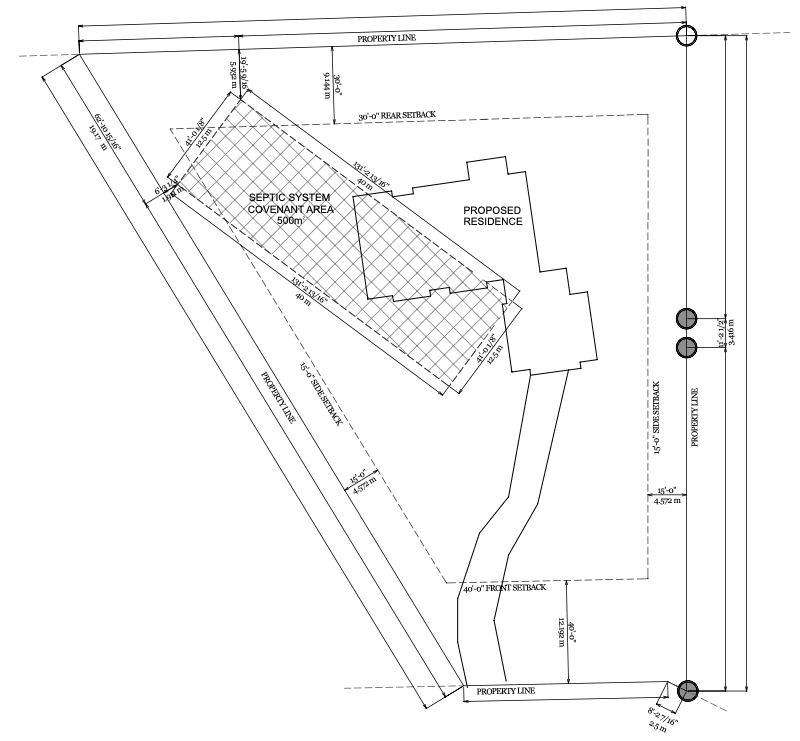
If you own rural land on Vancouver Island, you've probably met the ghost of regulations past: a septic covenant buried in your title. These restrictive covenants are legacy items from a bygone era, and they're a common reason people can't build the shop, suite, or accessory dwelling they want. The good news? They're modifiable or removable — and the process is faster and more predictable than most owners expect, routinely 5–10 weeks when done correctly.
Where did these covenants come from?
Before May 31, 2005, BC's old Health Act gave Island Health (and its predecessor, VIHA) direct authority over every septic system. When a new lot was created or a system permitted, the health authority frequently required a Section 219 covenant — a restrictive covenant registered under BC's Land Title Act — to be registered on title. This legally "reserved" the best piece of ground on the property exclusively for a future septic field, ensuring it could never be built on, paved, or filled.
The intent was solid public-health protection on a septic-dependent island, but the side effect is that thousands of properties still have these 30–50-year-old covenants locking up prime building areas.
Everything changed in 2005 with the Sewerage System Regulation — B.C. Reg. 326/2004, which came into force on May 31, 2005 — and the shift to a professional-reliance model. The Sewerage System Standard Practice Manual (now Version 3, released 2007 and updated since) made new covenants largely unnecessary. Health authorities stepped back from routine approvals, and today you'll almost never see a new septic covenant registered. The ones that remain are almost entirely pre-2005 relics.
The hard rule: no professional letter = automatic rejection
Island Health will not even open your application unless it includes a Covenant Assessment Letter prepared and sealed by an Authorized Person under the Sewerage System Regulation — either a Registered On-site Wastewater Practitioner (ROWP) or a Professional Geoscientist (P.Geo.) with wastewater expertise.
No letter → instant refusal. No exceptions.
I'm a P.Geo. who has extensive experience altering and removing these covenants Island-wide. Here's the exact four-phase process that works.
The four phases and real-world timelines
Phase 1 – Technical Feasibility Assessment (2–4 weeks)
This is where 95% of applications live or die. Island Health requires unequivocal, field-verified evidence that:
The original covenanted area is no longer suitable, and
An alternate area for the proposed septic covenant area meets or exceeds current Sewerage System Regulation standards.
There is sufficient evidence that the site has many suitable options for placement of a septic system, and the covenant is able to be fully removed.
That means test pits, soil logs, percolation tests, seasonal water-table assessment, slope surveys, and a professional site plan. The resulting Covenant Assessment Letter must be data-rich, unambiguous, and leave nothing open to interpretation. When it's done right, Island Health almost never asks for more information or a site visit.
Phase 2 – Covenant Release Package (1 week)
Current title & original covenant
Sealed Covenant Assessment Letter (P.Geo. or ROWP)
Land Title Form C – Release (prepared by your lawyer/notary)
$200 Island Health administrative fee
Phase 3 – Island Health Review (1–2 weeks)
Covenant Release Package submitted electronically → EHO reviews → Regional Manager signs → signed Form C emailed back.
Phase 4 – Land Title Registration (usually same week)
Your notary registers the release electronically and the covenant is gone.
Real-world result when the technical letter is bulletproof: 5–10 weeks total. My last three clients all successfully had Island Health septic system covenants removed in under 7 weeks. You'll find the full breakdown of what each phase involves on my septic covenant removal service page, and general cost guidance on the pricing page.
P.Geo. vs ROWP: why the difference matters
Both are legally authorized, but in practice the outcome is rarely equal:
Professional Geoscientists are regulated specifically in hydrogeology, soil science, and contaminant transport — the exact disciplines Island Health scrutinizes on tricky lots (high water table, shallow/fractured bedrock, steep slopes, small parcels).
Many ROWPs are outstanding designers and installers, but not all have the same depth in complex site hydrogeology or the professional weight that a P.Geo. seal carries when the reviewer has questions.
On marginal or complicated sites I've personally seen applications rejected under a ROWP letter, then approved in under two weeks when resubmitted under my P.Geo. seal with no changes to the data.
Bottom line: a properly qualified P.Geo. dramatically reduces risk, follow-up requests, and total timeline.
The fastest, lowest-stress path
I've refined this process to the point where most covenants are gone in 5–8 weeks. I know exactly what Island Health wants to see and how to present it so the reviewer can approve it the same day.
Most clients simply email me their PID (or civic address) and a copy of their title showing the covenant. I do a free desktop review and tell you straight up whether it's straightforward or what specific fieldwork will be required. No charge and no obligation until we both agree to proceed.
If the covenant is standing between you and a new lot rather than a new building, the same fieldwork usually feeds straight into a subdivision application — I've written separately about septic requirements for lot subdivision on Vancouver Island.
Frequently asked questions
What does Island Health charge to remove a septic covenant?
Island Health charges a $200 administrative fee, which is submitted with the Covenant Release Package in Phase 2. That fee is separate from the professional and legal costs — the technical assessment, and your lawyer or notary's work preparing and registering the Land Title Form C – Release. See the pricing page for how I quote the assessment side.
How long does the whole process take?
Most files run 5–10 weeks end to end: 2–4 weeks for the technical feasibility assessment, about a week to assemble the release package, 1–2 weeks for Island Health's review, and usually the same week for Land Title registration. My last three clients were all done in under 7 weeks. When the technical letter is bulletproof, most covenants are gone in 5–8 weeks.
Who is allowed to sign the Covenant Assessment Letter?
Only an Authorized Person under the Sewerage System Regulation — a Registered On-site Wastewater Practitioner (ROWP) or a Professional Geoscientist (P.Geo.) with wastewater expertise. Island Health will not open an application without a sealed letter from one of them. No letter means instant refusal.
Can a covenant be modified instead of removed outright?
Yes. Some sites support full removal, where the evidence shows the property has many suitable options for placing a septic system. On others the right outcome is altering the covenant — relocating the reserved area to ground that meets or exceeds current Sewerage System Regulation standards, which frees up the part you actually want to build on. The feasibility assessment is what determines which of the two your lot supports.
What do I send you for the free desktop review?
Your PID or civic address, plus a copy of your title showing the covenant. Email those to me and I'll tell you within a couple of days whether your file is straightforward or what specific fieldwork will be required. There's no charge and no obligation until we both agree to proceed. More detail is on the FAQ page.
Let's get it off your title
If an old septic covenant is holding your property hostage, let's get it altered or removed — properly, permanently, and as fast as Island Health will allow.
Send me your PID and title through the contact page today and I'll tell you within a couple of days exactly what it will take to get that covenant off your title for good. You can read the full scope of the service on the septic covenant removal page.
Life's too short to let a 40-year-old piece of paper dictate what you can do with your own land. Let's fix it.
Related reading
Type 1, Type 2, and Type 3 Septic Treatment Explained for Island Homeowners
July 15, 2026 · 10 min read
Is My Property Sub-dividable? Understanding Septic System Requirements for Lot Subdivision on Vancouver Island
August 25, 2025 · 3 min read
Protecting Vancouver Island's Coastal Waters: Septic Setbacks and Eco-Friendly Solutions
July 25, 2025 · 3 min read