
Type 1, Type 2, and Type 3 Septic Treatment Explained for Island Homeowners
Written by Jordan Huscroft, P.Geo. · Pacific Rim Wastewater Solutions Ltd.
Published · Updated · 10 min read
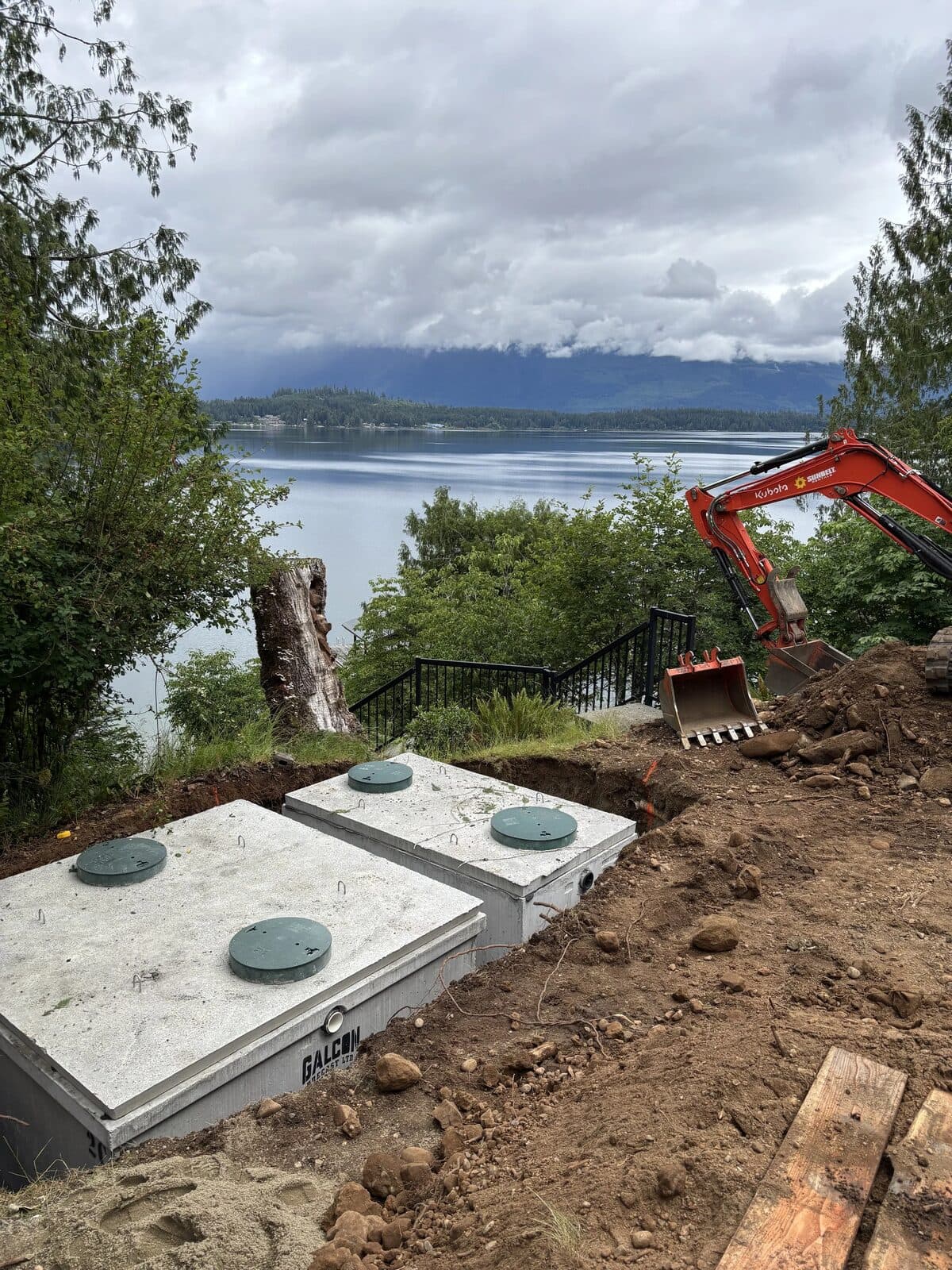
British Columbia's Sewerage System Regulation sorts every onsite septic system into one of three treatment classes, based on how clean the wastewater is before it soaks into the ground. Type 1 is a septic tank (with an effluent filter) and nothing more. Type 2 adds a treatment unit that brings the effluent down to under 45 mg/L of both organic strength (BOD5) and suspended solids. Type 3 goes further still — under 10 mg/L of each, plus disinfection to a median of fewer than 400 fecal coliform per 100 mL. Which one your Vancouver Island property needs is driven mostly by your soil, your water table, your setbacks, and your lot size — not by preference. Here's what each level actually means, and what pushes a site from one to the next.
The three treatment types at a glance
The "type" refers to the quality of the effluent leaving the treatment stage and entering the soil dispersal field — not to a brand or a specific technology. The cleaner that effluent is, the less work the soil has to do to finish the job, which is why higher treatment levels can be dispersed faster, in a smaller area, and on more difficult ground.
Type 1 (septic tank only): no numeric effluent standard; largest dispersal field; maintenance plan required; no effluent sampling; often needs a pump for pressure distribution; lowest cost.
Type 2 (treatment unit, under 45/45): under 45 mg/L BOD5 and suspended solids; smaller field; maintenance plan plus annual sampling for BOD and TSS; powered; higher cost.
Type 3 (treatment plus disinfection, under 10/10): under 10 mg/L BOD5 and suspended solids, and a median under 400 fecal coliform per 100 mL; smallest field; maintenance plan plus more frequent sampling (roughly quarterly, including fecal) and UV checks; powered; highest cost.
Effluent-quality figures are the Type 2 and Type 3 standards defined in the BC Sewerage System Regulation. Sizing and site rules come from the Sewerage System Standard Practice Manual, Version 3 (SPM V3).
Type 1: a septic tank and effluent filter (primary treatment)
Type 1 is the classic septic system most people picture. Raw wastewater flows into a septic tank, where solids settle to the bottom, grease and scum float to the top, and the clarified liquid in the middle passes through an effluent filter and out to the dispersal field. The tank removes solids and begins breaking down the waste, but it does not meaningfully reduce the dissolved organic load, the pathogens, or the nutrients. That final treatment happens in the soil itself, as the effluent trickles down through undisturbed native ground.
Because the soil is doing the real treatment, a Type 1 system only works where you have enough good, permeable soil above the water table or bedrock to safely finish the job. On the deep, well-drained sands and loams found on parts of the Island, Type 1 is often the simplest and lowest-cost choice — the lowest up-front price, no mechanical treatment plant to service, and decades of reliable life if the tank is pumped on schedule. One caveat worth knowing: many Island Type 1 systems still include a pump (and its alarm) to pressure-dose the dispersal field, so "simple" doesn't always mean "no power" — there's just no treatment unit to maintain. Where the soil is thin, wet, or tight, Type 1 alone runs out of room, and that's where the higher treatment levels come in.
Type 2: a treatment unit that reaches under 45/45 (secondary treatment)
A Type 2 system puts an active treatment step between the septic tank and the dispersal field. Most commonly that's an aerobic treatment unit — a tank that blows air through the effluent so oxygen-loving bacteria digest the organic waste — or an engineered sand filter that the effluent is dosed over. Either way, the goal is a defined effluent quality: consistently under 45 mg/L BOD5 and under 45 mg/L total suspended solids, roughly an 80–90% cut in organic load compared with plain septic-tank effluent.
That cleaner effluent matters for two practical reasons. First, it carries far less organic material, so the soil under the field doesn't have to work nearly as hard to stay aerobic and keep accepting water — which means the field can be loaded faster and built smaller. Second, it opens up sites that a Type 1 system can't legally use: on some tight, slowly-draining clay soils the regulation simply doesn't permit a plain septic-tank field, and adding Type 2 treatment is what makes dispersal possible at all.
Type 3: advanced treatment plus disinfection (under 10/10, disinfected)
Type 3 is the highest onsite standard. It takes secondary-quality effluent and polishes it further, then disinfects it — typically with an ultraviolet (UV) lamp or a chlorination step — to knock down the remaining bacteria. The result is a clear, low-odour effluent that meets under 10 mg/L BOD5, under 10 mg/L suspended solids, and a median fecal coliform density below 400 CFU per 100 mL.
Because a Type 3 system removes both the organic load and most of the pathogens before the effluent ever reaches the ground, it needs the least soil to finish treatment and can be dispersed in the smallest, shallowest field of the three. On Vancouver Island that's often the deciding factor: a high-water-table lot near a lake, a small parcel with tight setbacks, or a shallow-soil site over bedrock may only be buildable with a Type 3 system, because its disinfected effluent lets the designer reduce the vertical separation and field area the site otherwise couldn't provide. There's also an operational catch worth knowing up front: a Type 3 system must be maintained under the supervision of a qualified professional — it can't simply be serviced by any operator — which adds an extra layer of oversight, and cost, for the life of the system.
What pushes a site from Type 1 up to Type 2 or Type 3?
Homeowners often assume the treatment type is a choice about how "good" they want their system to be. In practice it's usually the site that decides, through the design rules in SPM V3. The main drivers are:
Soil permeability. Very coarse, fast-draining soils and very tight, slow soils both create problems for Type 1 — the fast ones don't hold the effluent long enough to treat it, and the slow ones can't accept it fast enough, so the natural clogging layer (the biomat) builds up at the infiltrative surface and the field slowly fails over time. Cleaner effluent widens the range of soils that will work.
Depth to the water table or bedrock (vertical separation). The regulation requires a minimum thickness of undisturbed soil beneath the field to finish treatment. Where that depth is short, cleaner effluent — especially disinfected Type 3 — lets a designer work with less of it.
Setbacks to wells, streams, lakes, and the ocean. Tight lots with water features nearby leave little room for a full-size Type 1 field; a smaller Type 2 or Type 3 footprint can fit where a Type 1 field won't.
Lot size and available area. On small or awkward parcels, the field simply has to be smaller — and the only compliant way to shrink it is to clean the effluent up first.
The size effect is concrete. Under SPM V3's loading tables, a typical medium-sand site might be allowed to disperse roughly 30 litres per square metre per day with Type 1 effluent. Move to Type 2 and that roughly doubles; move to Type 3 and it can reach about triple — so the same daily flow needs only about a third of the dispersal-field area it would as a Type 1 system. On a tight lot, that difference is often what makes the project work.
The cost and maintenance trade-off
Cleaner effluent is never free — but the trade-off is often misunderstood. First, every system, Type 1 included, must have a maintenance plan filed with the health authority, and many Type 1 systems on the Island still run a pump and alarm to pressure-dose the field, so they aren't necessarily power-free. What Type 1 doesn't need is a mechanical treatment unit or effluent lab sampling; its upkeep is pumping the tank every few years, rinsing the effluent filter, and checking the pump and alarm if it has them.
Type 2 and Type 3 systems add a mechanical treatment plant that draws power, has parts that wear, and must be serviced on the manufacturer's schedule — plus routine effluent sampling to prove it's still performing. Under the SPM, a Type 2 system is sampled for BOD and suspended solids (taught as roughly annual), while a Type 3 system is sampled more often — on the order of quarterly — for BOD, suspended solids, and fecal coliform, and its disinfection stage needs regular checks. That last point matters: a burned-out UV bulb quietly drops a Type 3 system back to Type 2 with no outward sign, which is exactly why the sampling and servicing are built in.
Which type will my Island property need?
There's no way to answer that from the road — it takes a site assessment. A designer digs test pits, identifies the soil texture and structure, finds the seasonal high water table and any limiting layer, measures the setbacks to wells and water bodies, and calculates the daily design flow for the home. Only then does the required treatment type fall out of the numbers. Two neighbouring lots can easily land on different types because their soils or water tables differ by half a metre.
The upside is that this is knowable early. A pre-design assessment tells you which treatment type your plans will require — and therefore the realistic cost and footprint — before you're committed, which is especially valuable if you're buying rural property or planning a build on a challenging Island lot.
Frequently asked questions
Is a Type 3 system "better" than a Type 1 system?
It produces much cleaner effluent, but "better" depends on the site. On a lot with deep, permeable soil and room to spare, a Type 1 system treats the wastewater perfectly well in the soil and costs far less to build and run. Type 3 is "better" only in the sense that it lets you build where a Type 1 field wouldn't fit or wouldn't comply. Matching the type to the site is the goal — not chasing the highest number.
Who decides which treatment type my system has to be?
The site and the regulation decide, and a qualified designer works it out. Under BC's Sewerage System Regulation, an authorized person (in our case a Professional Geoscientist) assesses the soils, water table, setbacks, and flow, then designs to SPM V3. The required treatment type is the outcome of that assessment, not a preference you or we get to pick freely.
What's the actual difference between Type 2 and Type 3 effluent?
Both are treated well beyond a plain septic tank. Type 2 gets organic strength and suspended solids under 45 mg/L each. Type 3 pushes both under 10 mg/L and adds disinfection to reduce fecal coliform to a median below 400 CFU/100 mL. In short, Type 3 removes far more pathogens, which is why it's allowed the smallest and shallowest dispersal fields.
Do all three types need maintenance and sampling?
All three must have a maintenance plan on file — that part is the same. The workload is what differs. A Type 1 system needs its tank pumped every few years, its filter rinsed, and its pump and alarm checked if it has them, but no effluent sampling. A Type 2 system adds a powered treatment unit and annual effluent sampling for BOD and suspended solids. A Type 3 system adds disinfection and more frequent sampling — roughly quarterly, and including fecal coliform — plus UV-bulb checks. So when you compare options, budget not just for the equipment but for the power, servicing, and lab sampling that Type 2 and especially Type 3 carry for the life of the system.
Can I upgrade a Type 1 system to Type 2 or Type 3 later?
Often yes — adding a treatment unit ahead of an existing field is a common way to fix a struggling system or to gain capacity — but it has to be designed and filed properly, and the existing field has to suit the change. It's worth having a designer confirm the path before you assume an upgrade will solve the problem.
Does a higher treatment type really shrink the dispersal field?
It does. Because cleaner effluent lets the soil accept water faster, SPM V3's loading rates roughly double from Type 1 to Type 2 and can roughly triple to Type 3 on the same soil. That's why higher treatment is the standard tool for making tight or difficult Island lots work.
Not sure which type your lot needs? Let's find out
The treatment type is one of the first things we pin down when we design a septic system, because it drives the footprint, the cost, and whether a lot works at all. If you're planning a build, subdividing, or buying rural property on Vancouver Island and want to know which treatment level your site will require, get in touch for a straightforward conversation, or learn more about our septic system design services. You can also browse more of our septic and wastewater articles for the Island.
About the author: Jordan Huscroft is a registered Professional Geoscientist (P.Geo., EGBC) with a master's degree in Integrated Water Resource Management from McGill University's Department of Bioresource Engineering and EOCP certification as a small wastewater systems operator. He is the principal of Pacific Rim Wastewater Solutions Ltd., based in Port Alberni, where he designs residential and commercial onsite sewerage and septic systems across Central Vancouver Island. He specializes in subdivision assessments and also handles waste discharge authorization permitting.
Related reading
Who Can Design Your Septic System in BC? ROWP vs P.Geo. vs P.Eng.
September 29, 2026 · 11 min read
How to Modify or Remove a Septic Covenant on Vancouver Island (2026 Guide)
November 27, 2025 · 6 min read
Is My Property Sub-dividable? Understanding Septic System Requirements for Lot Subdivision on Vancouver Island
August 25, 2025 · 3 min read