
Pricing
What a Septic Design Costs on Vancouver Island
Design and installation are two separate costs. A residential design package — research, assessment, drawings, Island Health filing and certification — is starting at $3,490 for SPM-compliant residential jobs, subject to exclusions, while the installation itself commonly runs $20,000 to $55,000 depending on system type. Your site, not a price list, decides where you land.
Ranges last reviewed October 2026 by Jordan Huscroft, P.Geo.
Try it · rough approximations only
What will my system cost?
1 · How much sewage
2 · What kind of system
Not sure which system your lot needs? That is what the site assessment decides.
Daily design flow
1,300 L/day
One home with 3 bedrooms: 1,300 L/day, from the BC Standard Practice Manual.
Installation, by a registered installer
$20,000 to $30,000+
Rough approximation · the high end can go higher
- Design through to certification
- from $3,490
- Flat fee for one home on a system that follows the Standard Practice Manual.
- Design and installation together
- $23,490 to $33,490+
- Before GST.
How this is worked out
- Flow. The Standard Practice Manual gives a 3-bedroom home 1,300 L/day (700 for the first bedroom, 300 for each one after).
- Installation. A gravity system for one ordinary home (up to 1,600 L/day) runs $20,000 to $30,000. This flow is within that, so the range is used as it is.
- Design. One home pays the flat fee for this system type, $3,490.
These are rough approximations for Central Vancouver Island, to help you plan, not a quote. There are always reasons a job can cost more, which is why every high end carries a plus: remote sites, difficult access, rock, imported sand and long pipe runs all push it up. A complex site is designed at a share of the installed cost rather than the flat fee: about 10% on smaller jobs, easing to about 5% on the largest. Your installed price comes from an installer once the design is done.
What does the design itself cost?
These are Pacific Rim Wastewater Solutions’ own fees, not a published guide: field work, soil logs, the sealed design, the Island Health filing, installation oversight and the final Letter of Certification. The design is priced separately from — and is much smaller than — the cost of building the system.
Residential septic system design
Starting at $3,490
For SPM-compliant residential systems, subject to exclusions. One fee, one professional, from the first research through to the certified system and the documents you keep. Exclusions: designs that depart from the manual, multi-unit and commercial systems, and complex sites, which are billed hourly on top or quoted.
What that includes
- Preliminary research
- Site assessment
- System design
- Site drawings
- Design report
- Submission to Island Health
- Installation oversight
- System commissioning
- Letter of Certification
- Maintenance plan
- Owner's manual
Complex sites — additional engineering
Quoted on scope
Additional engineering fees apply to complex sites with real limitations — setback reductions to sensitive water bodies, or sites where the Standard Practice Manual has to be departed from and a custom design developed and justified. The scope is agreed before the work starts.
Commercial / medium-flow design
Quoted per project
Medium-flow designs up to the 22,700 L/day limit require hydraulic calculations, treatment specification and a P.Geo. seal. Scope varies too much between a 12-site campground and a lodge for a published range to mean anything.
Holding tank application and design
Starting at $1,250
Design and filing for a holding tank application. Difficult sites are quoted. The Island Health application fee for a holding tank is $400.
Island Health filing fees
$200 filing
$200 to submit a filing for a Record of Sewerage System, and no charge to submit the Letter of Certification document. Holding tank applications are $400. These fees are generally included in the PRWS package rather than billed separately.
What does the installation cost?
Installation is priced once the design is done, and I review the installed price with you whether you hire your own installer or have PRWS arrange one. The figures below are typical prices from registered installers for tanks, pumps, pipe, sand, excavation and labour, listed by system type so you can see how much the type of system drives the total.
| System type | Typical installed range (CAD) | When it’s used |
|---|---|---|
| Type 1 — gravity | $20,000 – $30,000 | Septic tank plus a gravity dispersal field. Requires good soil, adequate depth to water table and bedrock, and enough room for the full field. |
| Type 1 — pressure distribution | $25,000 – $45,000 | Adds a pump chamber and pressurised laterals so effluent loads the field evenly. Common where soils are shallow, sloped, or unevenly permeable. |
| Type 1 — sand mound or sand lined bed | $35,000 – $55,000 | Builds the treatment depth the site does not have, using imported specification sand. The usual answer on thin soils over bedrock and on high-water-table lots. |
| Type 2 / Type 3 — treatment added | +$15,000 – $35,000 | Secondary (Type 2) or tertiary (Type 3) treatment reduces the dispersal area needed, which can make a tight lot buildable. It also brings an ongoing maintenance obligation and a service contract. |
Where these numbers come from: they are the typical ranges charged by the installation partners this practice works with on Central Vancouver Island. Remote sites — Bamfield, Tofino, Ucluelet, boat-access parcels — commonly sit above these ranges because of barging, road time, imported sand delivery and the travel costs of working remotely. Treat them as orientation, not as a quote.
Where does the money actually go?
Most people picture the tank. The tank is one of the smaller lines. This is roughly how a real installed system divides up, generalised from an actual project estimate and rounded — useful for understanding which decisions on your site move the total.
| Category | Share of installed cost | What it covers |
|---|---|---|
| Labour and machine time | ~37% | Excavator hours, operator and crew time — the largest single line on most installs. |
| Materials and components | ~30% | Tanks, pump, control panel, pipe, fittings, distribution hardware and risers. |
| Aggregate, sand and soil | ~10% | Specification sand, drain rock and cover soil. Rises sharply with haul distance. |
| Trucking and haul | ~9% | Getting the above to site. The line that moves most on remote and west coast parcels. |
| Design and engineering | ~6% | The sealed design and certification — a small fraction of what the finished system costs. |
| Other trades | ~5% | Electrical work and other trades brought in for the install. |
| PST | ~2% | Provincial sales tax on materials. Unlike GST, it is not recoverable and is carried in the cost. |
Shares are approximate and generalised from one representative project. Every site divides differently — haul distance in particular can move the aggregate and trucking lines substantially.
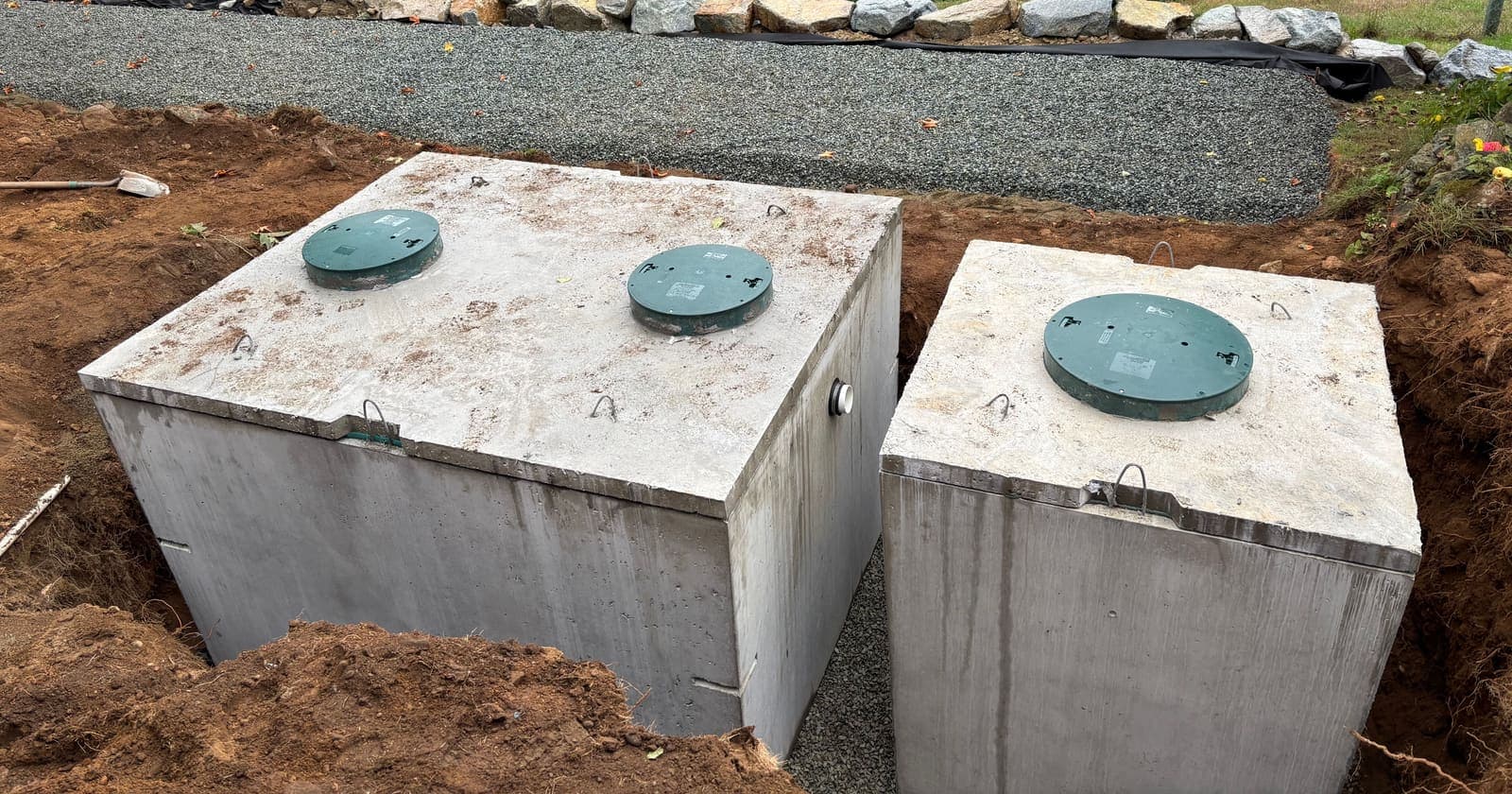
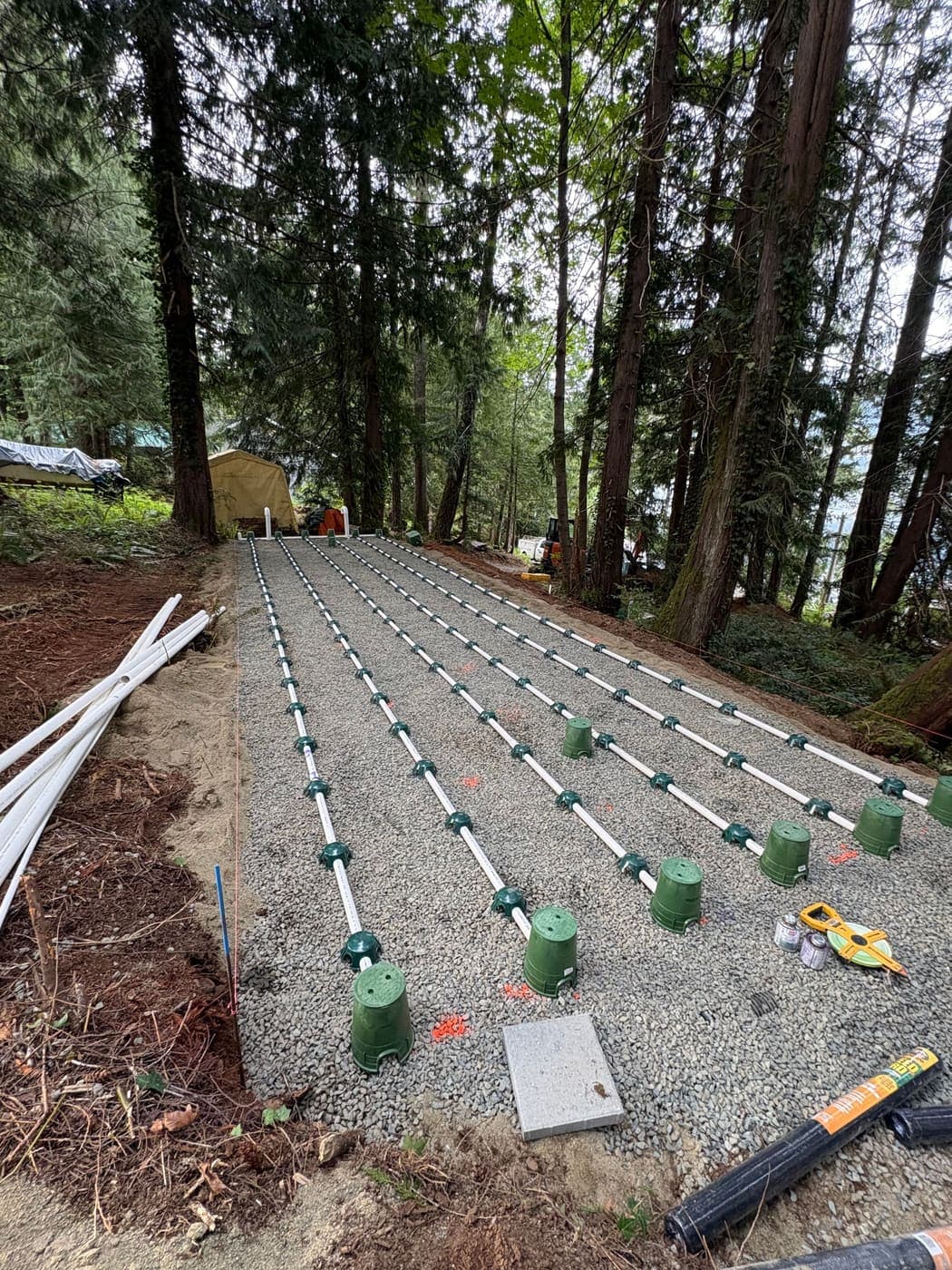
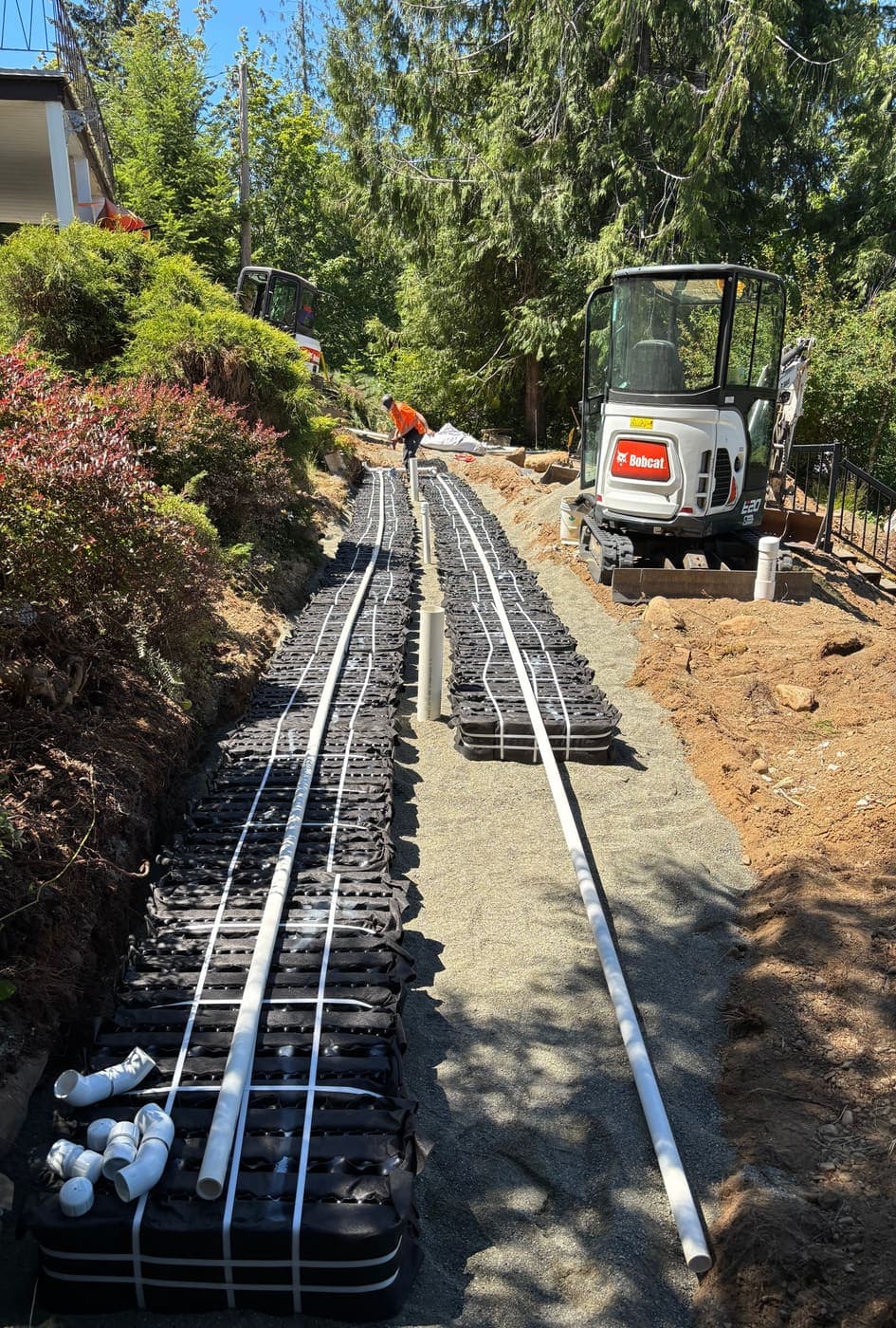
What do these system types actually look like?
What moves the number on your property?
Six factors explain almost all of the spread between a $22,000 system and a $75,000 one. None of them can be read off a listing.
Soil texture and depth
Soil is the treatment system. Deep, moderately permeable soil accepts a simple gravity field; thin soil over bedrock, dense glacial till, or very coarse sand all force a more expensive configuration — imported sand, a larger footprint, or added treatment.
Seasonal high water table
The SPM requires a minimum vertical separation between the dispersal field and the seasonal high water table or a restrictive layer. Where that separation does not exist naturally it has to be built, and building it is the single largest cost jump on many Island sites.
Lot size, shape and setbacks
Setbacks from wells, property lines, buildings, and fresh or marine water are mandatory. On a small or waterfront parcel the setbacks can consume most of the lot, leaving a dispersal area too small for a conventional system and pushing the design toward Type 2 or Type 3 treatment.
System type
Type 1 is a septic tank and dispersal field. Type 2 adds secondary treatment; Type 3 adds tertiary treatment and disinfection-grade effluent quality. Higher types cost more up front and carry ongoing maintenance, but need less dispersal area — sometimes the only way a constrained lot works at all.
Access, haul distance and remoteness
Excavator access, driveway grade, haul distance for imported sand, and barge or logging-road logistics all land in the installation quote rather than the design fee. A Bamfield or west coast site can carry a materially higher installed cost than an identical design in the Alberni Valley.
Bedroom count and design flow
Residential design flow is driven by the number of bedrooms, not the number of people living there today. Adding a bedroom later means a larger system — which is worth deciding before the design, not after the field is in the ground.
Why the design is settled first
Whether you take the design on its own or have PRWS arrange installation as well, the design is priced and settled on its merits before anyone prices the build. The system is specified for what the site needs, not to raise the value of an installation contract.
The arm’s-length model benefits the client in both directions. It guards against systems being built larger than the ground requires, and equally against systems being undersized to win a quote against a competitor. The design is settled on its merits first; the installers then price the same drawing, and you can compare their numbers like for like.
Why won’t anyone quote a fixed price sight-unseen?
Because the cost of a septic system is a fact about your ground, and nobody knows that fact until test pits are open. Two neighbouring parcels on the same road can need a $24,000 gravity field and a $50,000 sand lined bed respectively, for reasons that are invisible from the driveway.
A designer who commits to a firm system price over the phone is either padding heavily to cover the unknowns or setting up a change order later. The honest sequence is: a firm fee for the site assessment, a firm design fee once the scope is known, then installer quotes against a real design that they can all price the same way.
Be clear about what these ranges are. The design fees are Pacific Rim Wastewater Solutions’ own. The installation ranges are typical figures from the registered installers this practice works with, offered so you can budget realistically and recognise a quote that is out of step. Depending on the job, the installation contract sits with your installer or with PRWS, and any figure can only be confirmed for your property after a site assessment.
Cost questions, answered
How much does a septic system cost on Vancouver Island?
A residential design from Pacific Rim Wastewater Solutions starts at $3,490 for SPM-compliant residential systems, subject to exclusions, covering everything from preliminary research through to the Letter of Certification. Installation is priced separately once the design is done: roughly $20,000 to $30,000 for a Type 1 gravity system, $25,000 to $45,000 for pressure distribution, $35,000 to $55,000 for a sand mound or sand lined bed, with Type 2 or Type 3 treatment adding $15,000 to $35,000. Remote sites carry additional travel costs related to working remotely.
Is the design fee included in the installation price?
No. The design is always priced on its own, whether you take the design only or have PRWS arrange installation as well. Some firms bundle design and installation into one price, which can make paying for a design separately look like being overcharged. It is not. That design cost is built into the bundled price; you are paying for it either way. If you are installing a Type 2 or Type 3 system, you are paying for a design somewhere in the number, whether it is itemised or not.
Why won't you give me a fixed price over the phone?
Because the price is a property question, not a service question. Until test pits are open and the soil, water table, setbacks and usable area are known, any number is a guess — and a guess low enough to win the job is the most expensive kind. You will get a firm fee for the assessment, then a firm design fee once the scope is known.
What does a site assessment cost on its own?
The site assessment is part of the residential design bundle rather than a separate product. Where a property is uncertain enough that you want to know before committing to a full design, the assessment can be scoped on its own so you can stop after it if the ground turns out to be worse than hoped. Ask, and it will be quoted that way.
Does a Type 2 or Type 3 system cost more overall?
Up front, usually yes, and they require higher maintenance over the life of the system — that is the honest trade. But it is not a simple rule. Sometimes advanced treatment is what makes building possible at all on a lot that would otherwise not support a system. And sometimes a Type 2 system genuinely works out cheaper than the alternative, because reducing the dispersal area avoids a much larger imported sand field and all the haul that comes with it.
Are there fees beyond design and installation?
Fewer than most people expect. The Island Health filing fee is generally included in the PRWS pricing package rather than billed on top. Most systems other than simple gravity need an electrical contractor to wire the system in, but that is typically bundled into the installation price. The cost that genuinely does continue is maintenance — think of it like an oil change for your car. It is a small price to pay to stop the system failing early, and to get the service life it was designed for.
Payment. Invoices are payable by the usual methods, including e-transfer. Bitcoin is also accepted for clients who prefer it — just mention it when the invoice is issued.
More questions on process, permits and timelines are on the FAQ hub, and local cost drivers are covered on each service area page.
Tell me about the property
A civic address or PID and a line about what you want to build is enough to start. You will hear what the site is likely to need, and what it is likely to cost, before you spend anything.